October 04, 2026
Buying your first set of hand tools is a balancing act. Spend too little and you'll fight your equipment on every job: a tape that reads differently each time you open it, a saw that wanders off your line, a chisel that folds over at the first knot. Spend too much and you'll own beautiful tools you barely touch while the basics are still missing.
The list below is what most carpenters reach for, day after day. It's deliberately short. Add to it as the work demands, not because a catalogue looked convincing.
Measuring and Marking: Get This Right and Everything Else Follows
Every cut starts as a mark, and a mark is only as good as the tool that made it. If your measurements drift, no amount of sawing skill will rescue the job.
Start with a tape measure in the 5m to 8m range. Look for a blade that stands out on its own for a reasonable distance, clear markings, and a hook that doesn't wobble. Tape hooks are designed to slide by their own thickness so inside and outside measurements both read true — but cheap ones slide too much. Test yours by measuring from the 100mm mark instead of the end, then subtracting. Plenty of carpenters work that way permanently, and it removes a whole class of errors.
A combination square is the workhorse. It gives you 90 and 45 degree marks, a straight edge, a depth gauge and a scribing surface in one tool. Buy a decent one, because a square that isn't square will quietly ruin everything you build. Check it by drawing a line against a known straight edge, flipping the square over, and drawing again. The two lines should sit on top of each other.
Add a 150mm steel rule for fine work, a marking knife for joinery, and a carpenter's pencil — flat and oval so it doesn't roll off the bench. A knife line is narrower than a pencil line and gives a chisel something to sit in, and that difference matters when you're fitting a joint.
Cutting Tools: Saws and Chisels
Saws
You need three saws before you need a fourth. A crosscut panel saw around 500 to 550mm for general timber, a tenon saw for accurate joinery and shoulders, and a coping saw for scribing skirting and cutting curves. If you prefer Japanese saws, a ryoba covers ripping and crosscutting on one blade, with a thin kerf that's easy to steer.
Whatever you buy, learn to start a cut properly. Mark the line, set the saw on the waste side of it, guide the first two or three strokes with your thumb, then let the saw do the work. Hardpoint saws are disposable, so don't worry about sharpening them — but a sharp saw beats an expensive blunt one every single time.
Chisels and Sharpening
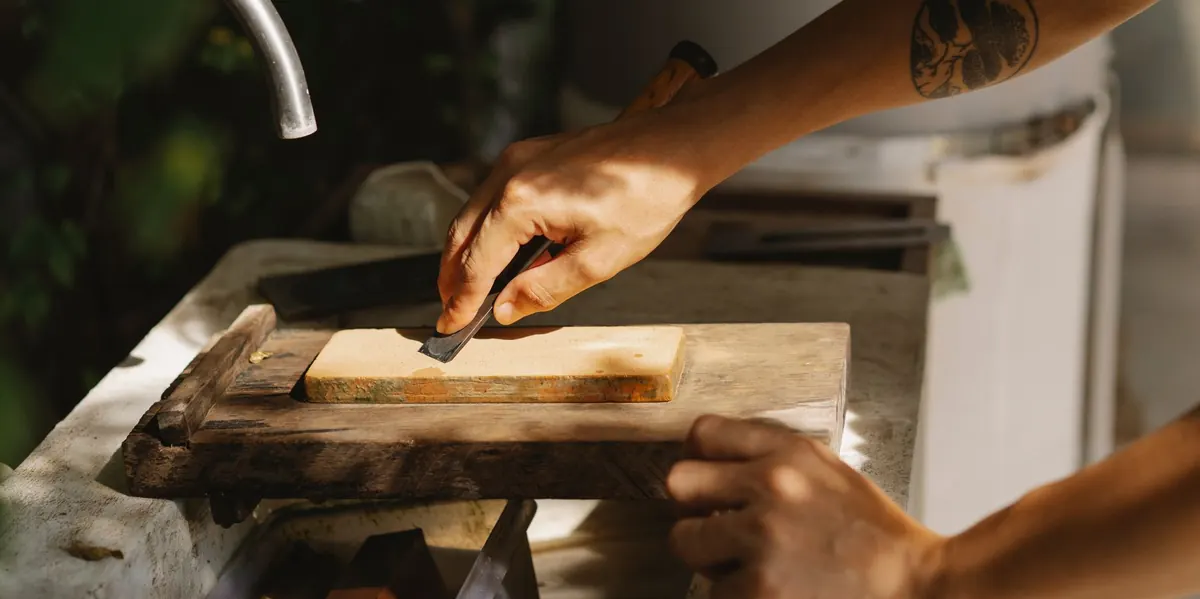
A set of bevel-edge chisels from about 6mm to 25mm covers almost everything, and adding a 25mm firmer chisel gives you something to chop with. Be honest about this, though: the chisel is only half the tool. The other half is your sharpening setup. A combination water stone, a diamond plate for flattening it, and a simple honing guide will keep an edge working far better than any upgrade you can buy.
Striking Tools and Their Small Allies
A 16oz claw hammer suits most site work. Go heavier, around 20oz, if you're driving framing nails all day. Swing from the wrist and let the head's weight do the work rather than forcing it — you'll hit straighter and your elbow will thank you later.
Then fill in the small items that save you time:
- Nail set for punching heads below the surface
- Pincers for pulling nails without tearing the timber
- Wooden mallet for striking chisels and assembling joints
- Pry bar or small wrecking bar for lifting and levering
- Utility knife with a pack of spare blades
Clamps: The Tool Nobody Buys Enough Of
You can't glue or assemble accurately without holding the work still, and no carpenter in history has complained about having too many clamps. Start with four F-clamps in the 300mm range and two quick-grip style clamps for lighter work. Add sash clamps when you start building frames and doors, and a couple of small 150mm clamps for fiddly repairs.
A pair of trestles or a solid bench matters just as much. Working at the wrong height makes good tools feel bad.
What to Buy First
If money is tight, work in this order. Each step earns its place before you move to the next one.
- Measuring and marking: tape, steel rule, combination square, pencil, marking knife. Nothing else works without these.
- Hammer, nail set, pincers. Inexpensive, used constantly.
- One good chisel set plus sharpening gear. Buy the sharpening kit at the same time as the chisels, not months later.
- Saws: panel saw, tenon saw, coping saw.
- Clamps and a bench or trestles.
- Safety kit: eye protection, hearing protection, dust mask. It sits at six only because it costs so little — buy it on day one.
Two buying habits are worth building now. First, secondhand quality usually beats new budget gear, especially for saws, squares and chisels; older tools were made to be maintained and repaired. Second, avoid huge sets. A forty-piece kit at a bargain price fills a bag with things you'll never touch and buries the three tools you actually need.
Looking After the Kit You've Got
Tools that are sharp, dry and stored properly will outlast the enthusiasm that bought them. Wipe steel down with a light oil after damp days, keep chisels in a roll rather than loose in a bag, and never drop them edge-first into a toolbox. Files and saws get their own space.
Set a routine: ten minutes of sharpening at the end of a job beats an hour of struggling with a blunt edge in the middle of one. Check your square against a straight edge every few months. Replace utility blades before they start tearing rather than slicing.
And if hand tools are new to you, get some hands-on teaching. A short evening course or a day alongside an experienced carpenter will teach you more about sawing to a line and sharpening an edge than any amount of reading. Ask about safe technique for anything you're unsure of, and wear the safety gear even on quick jobs. Build your kit around the work you actually do, and it will keep earning its place for years.
Photo: Ono Kosuki / Pexels